The draft model scores champion picks from what is visible in champ select: the champions on both sides and, on a paid plan, your own play history. It returns a win probability and an explanation for every candidate.
The hard part is that a live draft rarely shows the full board.
Incomplete Information
A completed match has ten champions, five positions per side and a result. Training data looks like that. A live draft shows your team's positions, the enemy's locked champions without their lanes, and nothing of the picks to come.
Serving handles this with position inference. Training handles it with masking.
Position Inference
In live champ select, enemy champions appear without positions. When two of them flex between the same roles, more than one assignment is valid.
Winrate measures how often each champion is played in each role in your rank bracket, tries every way of giving the enemy champions distinct positions, and keeps the assignment whose role shares multiply to the largest number.
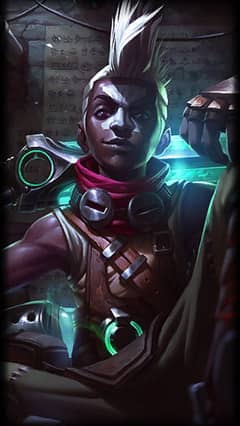
Take Diana and Ekko in Iron to Platinum (shares read October 10, 2026). Diana is played mid in 53.6% of her games and jungle in 43.4%. Ekko is 49.8% mid and 45.5% jungle. Both prefer mid, and only one can have it:
- Diana mid, Ekko jungle: 0.536 × 0.455 = 0.244
- Diana jungle, Ekko mid: 0.434 × 0.498 = 0.216
Diana gets mid. The model scores every candidate against that one assignment, and with options this close the guess can be wrong (see Limits).
Masking During Training
Training examples come from completed matches, where all ten champions are known. Training hides champions the way a draft would.
Each example is one player's pick, given one of its side's five pick turns at random. Each team keeps as many champions visible as it had locked before that turn. The player's own slot is empty, and each remaining teammate is shown half the time, standing in for a hover. A hidden champion becomes an unknown token and its matchup or synergy input a missing value.
 Garen
Garen Lee Sin
 Ahri
Ahri Jinx
Jinx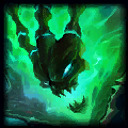 Threshvs
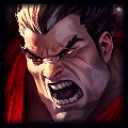 Darius
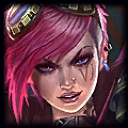 Vi
Vi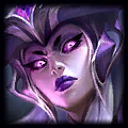 Syndra
 Ezreal
 LuluAhri?hidden?hiddenvs?hidden?hidden?hidden?hidden?hiddenGarenLee SinAhri?hidden?hiddenvs?hiddenVi?hiddenEzreal?hiddenGarenLee SinAhriJinx?hiddenvsDariusVi?hiddenEzrealLulu
Without masking, the model would only learn to score a pick with the other nine champions visible: the last pick of a draft, where you need the least help.
Two Models
Both models are gradient-boosted trees, 1,000 each. Their stats come from ranked solo games on the six newest patches, in two rank brackets (Iron to Platinum, Emerald and above), refreshed several times a day. A champion is rated in a position once it has 100 games there.
Anonymous Model
63 inputs, free:
- Champion stats: win rate, pick rate, first blood rate, crowd control, damage split, scaling (win rate in games past 30 minutes minus games under 25), and win rate on the current and previous patch.
- Matchups and synergy: win rate against each visible enemy and with each visible ally, by position, for pairs with at least 50 games.
- Team composition: each team's average win rate, crowd control, damage split, damage taken, scaling and count of Tanks and Fighters.
- Board and champion type: the ten slots, side, position, rank bracket, and the candidate's class tags and two playstyle clusters from the champion embeddings. Orianna and Viktor share both clusters.
Personalized Model
123 inputs: the 63 above plus 60 from your own ranked solo games on the same six patches. It needs a paid plan and a fully synced match history. Without both, you get the anonymous model.
- This champion: games, wins, KDA, CS, damage and vision per minute, first bloods, solo kills, gold, CS and XP difference at 10 minutes, and how recently you played it.
- All champions: the same rates across your pool, your win rate, your rank and this position's share of your games.
- Similar champions: your record on champions sharing the candidate's tags and clusters, which covers champions you have not played.
- Form: win rate over your last 20 games, games in the last 24 hours and your last result.
How Accurate It Is
Both models were trained on 589 million picks from patches 16.13 to 16.18 and tested on the next patch: 2.9 million picks from 295,419 matches on 16.19, masked the same way, with matchup stats taken only from games before each test game's day.
The measure is AUC: the chance that the model scores a pick that won above a pick that lost. A coin flip is 0.50 and a perfect model 1.00. The anonymous model scores 0.552 and the personalized model 0.573.
What that means for a player:
- Draft decides a small part of a game. 0.55 is a real edge and a small one. Our in-game win probability model, which reads gold, kills and objectives, scores above 0.8 on the same measure.
- The percentages can be read at face value. Group the test picks by predicted win chance, and predicted and actual win rates differ by 0.04 points on average (0.22 personalized).
- Near-ties are ties. The Draft tool groups candidates into one-point bands. In the example below the top three supports sit 0.1 points apart, and a second read the same evening had them in a different order.
- Your history is worth more than extra draft inputs. It adds two points of AUC. Seven further groups of draft-only inputs, tested together, added a tenth of a point.
The test scores the picks players made. It does not measure what happens when a player switches to the model's first choice.
SHAP Explanations
Every prediction can be opened to see what moved it. TreeSHAP splits the model's output into a baseline plus one contribution per input, and they add up to the prediction.
Here is a real one: the last board in the masking figure, support open, Iron to Platinum, anonymous model, read October 10, 2026. Braum came first of 52 supports at 59.96%. Open the board in the Draft tool to see today's numbers.
- The board does much of the work. All 52 supports were rated above 50%. The two teams' average win rates (48.8% for the enemy, 50.4% for the allies) add 2.8 points for Braum and the same for Leona in second.
- Braum's own case is matchups and synergy: 53.0% on average against the four visible enemies and 55.0% with Jinx.
- A good-looking value can subtract. Braum's 51.4% win rate costs 0.7 points, because each contribution is measured against what the model expects.
The breakdown belongs to this board. A bar shows how far the model's estimate moved when it saw an input, which is weaker than proof that the input wins games.
The AI assistant on the Draft page reads the same predictions and explanations for the board you have open.
Limits
One position assignment. A candidate that is strong into Diana mid and weak into Diana jungle is a gamble the model does not show. Scoring across several assignments, which would also show the pick that holds up in the worst case, is not built.
No pick order. Our match data has no pick order, so training draws pick turns at random. The model cannot learn that a champion does better as a late counterpick than as a blind first pick.
Early picks have little to go on. On a first pick every matchup input is missing, and the estimate rests on champion stats and, when personalized, your history.