








What's the best League of Legends draft AI? We benchmarked the three public ones (Winrate, iTero, and LoLDraftAI) against each other on real ranked games. Here's what we found.
We took 20,000 real ranked solo-queue games. For each one, we hid a single champion pick and asked all three draft AIs: "what do you recommend here?" Then we checked: when the player's actual pick was near the top of a site's list, did that team go on to win the game?
Winrate's recommendations had the highest win rate, in every bucket we measured.
When the actual pick was in Winrate's top 10, the team won 55.1% of the time. iTero: 52.9%. LoLDraftAI: 49.8%. The pattern got stronger when we tightened the bucket: if the actual pick was Winrate's #1 recommendation, the team won 58.7% of the time.

Meet the Tools
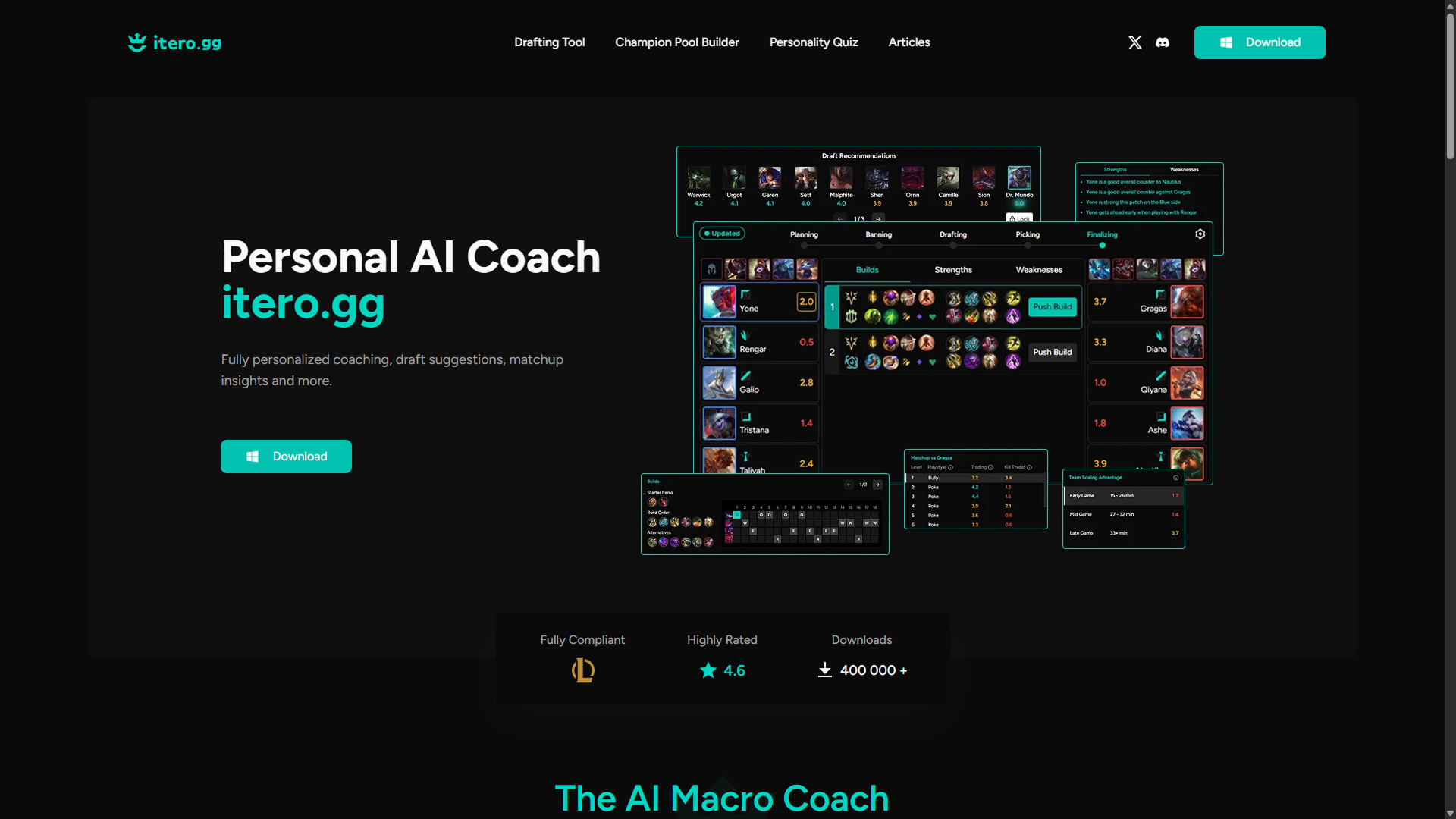
iTero
itero.gg. Public drafting tool from iTero Gaming, a UK startup founded in late 2021 by Jack J. Their model combines gradient-boosted trees with linear models. The most established of the three and the most popular AI draft tool in the LoL community; their Overwolf desktop coach has been around since August 2022.
Winrate
winrate.gg. Our own. Brand new. Gradient-boosted-tree model with 58 hand-engineered features (champion stats, pairwise matchups and synergy, team composition, playstyle clusters), with TreeSHAP explanations on every recommendation. Has anonymous and personalized variants; this article tests only the anonymous one. How it works →
LoLDraftAI
loldraftai.com. Also new; current model released May 2025. A single neural net taking champions, patch, and elo as inputs. Open source, with public training logs on Weights & Biases.
Notable mentions
A few other names come up in this space that we didn't test:
- DraftGap. Returns champion suggestions from static aggregate stats (per-champion win rates, pairwise matchup tables, synergy tables) rather than a learned model. Useful as a stat lookup, but not the same category of tool.
- LoLTheory. Has a draft tool, but LoLDraftAI published a head-to-head where they outperformed it. Since LoLDraftAI is already in the benchmark and finished last, including LoLTheory wouldn't change the outcome.
The Headline Chart
The biggest, most stable bucket: when the player's actual champion was somewhere in the site's top 10 recommendations, what fraction of those games did their team win?
That's a 5.4-point spread between top and bottom. The kind of gap you don't get from noise on a 20,000-game sample.
Tightening the Bucket
If a draft model is well-calibrated, the picks it ranks #1 should win more than the picks it ranks #5, which should win more than the picks it ranks #10. Confidence and outcomes line up.
Here's each site, broken out by how confident their ranking was on the actual pick.
Top-K win rate. n is the number of games where the actual pick was in the site's Top K.
For Winrate, the curve goes the right way: confidence and outcomes line up.
- Top 10 → 55.1%
- Top 5 → 55.2%
- Top 3 → 56.0%
- Top 1 → 58.7%
The picks Winrate ranked highest were the picks that won the most. That's what a calibrated draft model is supposed to do.
The other two sites don't show that pattern. iTero's #1 picks (52.7%) actually win less often than its top 5 (53.8%). LoLDraftAI sits within a point of 50% (coin flip) across every bucket.
How the Test Works
- Pull a real ranked solo-queue game out of the database.
- Pick one of the ten slots in that game (one team, one role).
- Erase only that one champion. Leave the rest of the draft visible.
- Send the resulting half-finished draft to each site and ask: "give me your ranked list of recommendations for this slot."
- Look up where the actual champion the player picked landed in each list.
- The actual win or loss of that game is the outcome.
If the player picked something the site ranked highly, and that team went on to win, that's a point for the site. Do this 20,000 times across three sites, then add it up.
A good draft model is one where the picks it likes most are also the picks that win most. A bad draft model is one where its top recommendations win at the same rate as its bottom ones.
The sample:
- 20,000 real ranked solo-queue games (queue 420)
- Gold tier and above
- Recent live patches
- Both teams' five roles assigned
- Only the one evaluated champion is hidden from the model
Reproducibility
This is a one-line summary, so here is the work itself.
The query that picked the games
For each match we then loaded the ten participant rows (champion_id, position, team_id, win) and picked one slot to evaluate.
What we sent to each site
Each site exposes a public recommendation endpoint that its own UI talks to. We posted the masked draft to each one and parsed the ranking.
The runner
Each row of our 20,000-game sample goes through the same loop:
What This Does Not Prove
This is a correlation, not a causal experiment. We didn't tell anyone to follow the recommendation. We checked: when real players locked in champions a site ranked highly, did their teams go on to win?
A good draft model should correlate with winning picks on real ladders. That's the bar. It clears the bar, but it doesn't prove that you, individually, would convert a 49.8% pick into a 55.1% pick by switching tools. Drafting better is a piece of winning more, not the whole thing.
This is also where the personalized model gets interesting. The anonymous model can only ever say "this pick wins more on average." The personalized one knows whether you play the candidate well, whether you've played it recently, and whether this is even your role. That's a step closer to causal: not just "what wins for the average player in this draft" but "what's likely to win for you, given your history." Still not a randomized trial, but much closer than the anonymous bar.
A Note on the Personalized Model
The numbers above are Winrate's anonymous draft model: same input every time, no idea who's picking.
iTero supports personalization too (their drafting endpoint accepts mastery data and per-role weightings). Winrate goes much deeper. The personalized model adds roughly 40 features per pick: champion-specific KDA / CS/min / damage/min / vision, time since last played, recency in the last 7 days, your global solo-queue averages, position familiarity, gold and CS differentials at 10 minutes, and your performance on similar champions in the same playstyle cluster.
We expect that work to widen the gap, not close it.
Wrapping Up
We didn't expect this much daylight between the three. iTero is well-built and well-known, LoLDraftAI publishes a clean, openly-trained model, and both are reasonable picks if you're looking for a draft AI today. On this benchmark, though, the picks Winrate ranked highly were the picks that won most often, and Winrate was the only one of the three where higher confidence translated into a higher win rate.
That's the most direct evidence we have so far that, on the question of which League of Legends draft AI helps you find winning picks, Winrate is currently the strongest of the public options.
Happy to run more benchmarking if these results spark any contention.